Modernism
- Definition: Modern character, tendencies, or values; adherence to or sympathy with what is modern.
- Background: Modern Art refers to art created roughly between 1867 and 1975.
Major movements included Impressionism, Cubism, Surrealism, Abstract
Expressionism, and Pop Art.
In 1907, Pictorialism
was challenged by a new way of photography called ‘Straight Photography’ which
is photography that is sharp and clear, based upon only what the camera could
do, un-manipulated in the darkroom.
· Paul Strand: –
o
‘Wall
Street (1915)’
o
‘Blind
Woman (1916)’
o
‘Fifth
Avenue (New York 1915)’
o
‘Portrait
(Washington Square Park 1916)’
o
‘Lathe No.
3 (New York 1923)
Paul Strand (October
16, 1890 – March 31, 1976) was an American photographer and filmmaker who,
along with fellow modernist photographers like Alfred
Stieglitz and Edward Weston, helped establish photography as an art
form in the 20th century. His diverse body of work, spanning six decades,
covers numerous genres and subjects throughout the Americas, Europe and Africa.
Photo Realism – moving away from
pictorialism
Modernist Painter: Arthur Dove, Marsden Hartley, Charles Scheeler,
Charles Demuth, John Marin, Georgia O'Keeffe, Abraham Walkowitz, Gerald Murphy,
Edward Hooper
Modernist
Photographers: Alfred Stieglitz, Paul Strand
Charles Scheeler :
- American painter who is best known for his precise renderings of industrial
forms in which abstract, formal qualities were emphasized.
- Sheeler studied at the School of Industrial Art in Philadelphiaand then at the
Pennsylvania Academy of Fine Arts. He contributed six paintings, mainly still
lifes, to the New York Armory Show of 1913.
- To make a living, Sheeler turned to photography about 1912. Initially he worked
on assignments from Philadelphia architects. He moved to New York City in 1919
and the next year collaborated with the photographer Paul Strand on a film,
Mannahatta, a study of the buildings of the city. During the early 1920s he
received recognition for both his paintings and his photography. In 1927 he
made an outstanding series of photographs of the Ford Motor Company's plant at
River Rouge, Mich. This assignment was followed in 1929 by a series on the
Chartres cathedral, France.
Man Ray (born Emmanuel Radnitzky, August 27,
1890 – November 18, 1976) was an American modernist artist who
spent most of his career in Paris, France. He was a significant
contributor to the Dada and Surrealist movements, although
his ties to each were informal. He produced major works in a variety
of media but considered himself a painter above all. He was best
known in the art world for his avant-garde photography, and he was a
renowned fashion and portrait photographer. Ray is also noted for his
work with photograms, which he called "rayographs" in reference
to himself.
Avant-garde
refers to people or works that are experimental or innovative,
particularly with respect to art, culture, and politics.
Avant-garde
Photography was the type of photography that interested me the most out of the
Modernist movement. My favourite of the avant-garde photographer’s was Diane
Arbus.
(March
14, 1923 – July 26, 1971) was an American photographer and writer noted for
black-and-white square photographs of "deviant and marginal people
(dwarfs, giants, transgender people, nudists, circus performers) or of people
whose normality seems ugly or surreal". Arbus believed that a camera could
be "a little bit cold, a little bit harsh" but its scrutiny revealed
the truth; the difference between what people wanted others to see and what
they really did see – the flaws. A friend said that Arbus said that she was
"afraid ... that she would be known simply as 'the photographer of
freaks'", and that phrase has been used repeatedly to describe her. In
1972, a year after she killed herself, Arbus became the first American
photographer to have photographs displayed at the Venice Biennale. Millions
viewed traveling exhibitions of her work in 1972–1979. Between 2003 and 2006,
Arbus and her work were the subjects of another major traveling exhibition, Diane
Arbus Revelations. In 2006, the motion picture Fur, starring Nicole
Kidman as Arbus, presented a fictional version of her life story
 |
|
A young man in curlers at home on West 20th Street, N.Y.C. 1966
Child with a toy hand grenade in Central Park, N.Y.C. 1962
Child with a toy hand grenade in Central
Park, N.Y.C. 1962
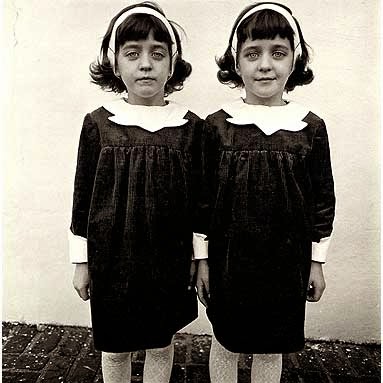
Identical twins, Roselle, New Jersey 1967

Boy with a straw hat waiting to march in a
pro-war parade, N.Y.C. 1967
Xmas tree in a living room in Levittown, Long
Island 1963
"Freaks
was a thing I photographed a lot. It was one of the first things I photographed
and it had a terrific kind of excitement for me. I just used to adore them. I
still do adore some of them. I don't quite mean they're my best friends but
they made me feel a mixture of shame and awe. There's a quality of legend about
freaks. Like a person in a fairy tale who stops you and demands that you answer
a riddle. Most people go through life dreading they'll have a traumatic
experience. Freaks were born with their trauma. They've already passed their
test in life. They're aristocrats." - Diane Arbus


